
The Hero
The Great (World) War (One)
World War I took place between July 1914 and November 11th, 1918, in which more than ten million people died in this conflict, on an unprecedented scale.
The reason the war broke out is much more complex than the assassination of Archduke Ferdinand of the Austro-Hungarian Empire in Sarajevo (July 1914) – the real causes are much deeper and still deserve continued debate and discussion today.
Portugal will mobilize more than 100,000 men for the Army and Navy of Portugal, in which approximately 12,000 Portuguese soldiers died during the conflict, including Africans who served in its armed forces on the colonial fronts.
However, civilian deaths in Portugal surpassed by many tens of thousands the military deaths, caused either by food shortages or by the Spanish flu between 1918 and 1921!

Portugal in the Great War
With the fall of the Portuguese Monarchy (in 1910) and the advent of the First Republic, Portugal will try to avoid, without success, the system of alliances involved in the First World War and divided between the “Guerristas” (the war supporters) and the supporters of neutrality at the beginning of the conflict in 1914.
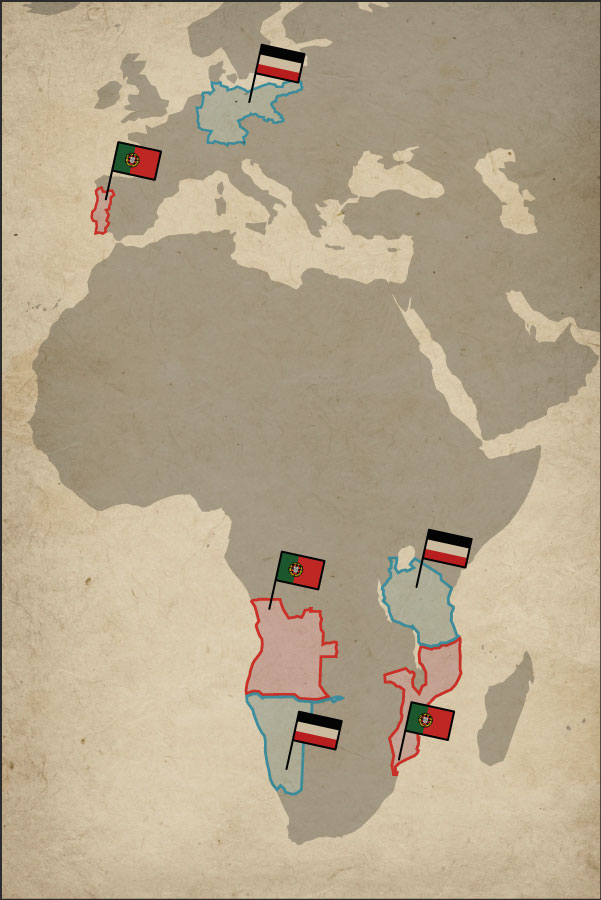
Portugal wanted to protect its colonies in Africa, clashing with German troops in the south of Portuguese West Africa (Angola), which bordered German Southwest Africa (Namibia), in 1914 and 1915.
Portugal only formally entered the War on March 9th, 1916, after the official declaration by the Government of Berlin.
The Moment

Aníbal Augusto is placed in the line defended by the Portuguese Expeditionary Corps (C.E.P.) in Flanders region.
On April 9th, 1918, the German “Georgette” offensive began, which intended to break through the Anglo-Portuguese line towards the Port of Antwerp, on the coast of the English Channel, having reached the 2nd Division of the C.E.P.
The Portuguese troops, who were exhausted, were quickly crushed and the C.E.P. started to give in.
Instead of withdrawing, Milhais, alone, ran along the trench lines of his sector, to try to delay the advance of the German troops that were advancing towards the Portuguese positions, firing from different positions, deceiving the German troops, that there would still be troops from the 2nd Division of the C.E.P. in that sector…
In the battle of La Lys around 400 Portuguese soldiers died and more than 6500 were taken prisoner, breaking the C.E.P. as a combat unit at the divisional level.
The Acknowledgment

Aníbal Milhais, already without ammunition for his gun, managed to survive for a few days, with what was left of his meagre rations, until he found an officer from the English Division of the sector who helped him to return to what was left of the 15th Infantry Regiment and who told the Portuguese soldier feat.
The Legend was born, it is based on truth.
Nicknamed Milhais, given his bravery, the commander embraced him, saying “You are named after Milhais, but you are worth millions”.
From here everyone knew him as the “Soldier Millions”.
For this feat, he received the highest Portuguese military decoration – the Military Order of Tower and Sword, of Valor, Loyalty and Merit – still in Flanders in 1918.

The Man
Aníbal Augusto Milhões – the origins, the Family, the customs.

The Territory
The Human and Natural Heritage, the typical products, the landscape, the stories.

The House
The Family home, the architecture, the community, “serving others”.
© 2023 Cultunatura Lda.